
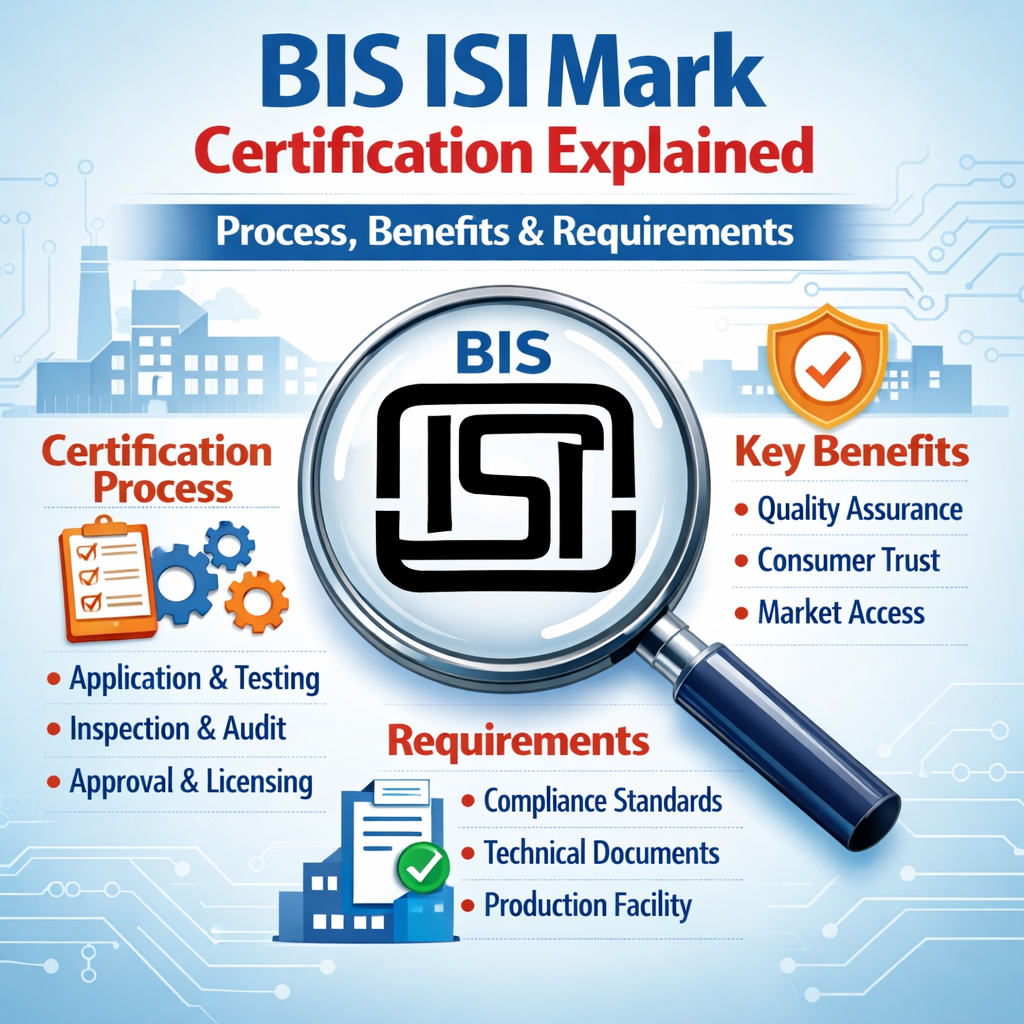
BIS ISI Mark Certification Explained: Process, Benefits & Requirements
In today’s competitive and quality-driven market, ensuring product safety and compliance is not just a regulatory requirement—it’s a business necessity. One of the most important certifications for manufacturers in India is the BIS ISI Mark Certification, issued by the Bureau of Indian Standards (BIS). This certification assures consumers that a product meets established quality, safety, and performance standards.
In this blog, we’ll explain everything you need to know about BIS ISI certification, including its process, benefits, and requirements.
What is BIS ISI Mark Certification?
The ISI Mark is a certification mark issued by BIS for products that comply with Indian Standards (IS). It is mandatory for various products under Quality Control Orders (QCOs) issued by the Government of India.
The ISI mark signifies:
- Product quality and safety
- Compliance with Indian Standards
- Reliability and performance assurance
Manufacturers must obtain a BIS license before using the ISI mark on their products.
Products Covered Under ISI Certification
BIS certification applies to a wide range of products, including:
- Electrical appliances (switches, cables, transformers)
- Construction materials (cement, steel, pipes)
- Consumer goods (kitchen appliances, packaged products)
- Industrial equipment
The list of mandatory products continues to grow as the government strengthens quality regulations.
BIS ISI Certification Process
Obtaining BIS certification involves a structured process. Here’s a step-by-step overview:
1. Product Identification
Determine whether your product falls under mandatory BIS certification and identify the applicable Indian Standard (IS).
2. Application Submission
Submit the application along with required documents through the BIS portal.
3. Product Testing
Samples are tested in BIS-approved laboratories to ensure compliance with relevant standards.
4. Factory Inspection
BIS officials conduct an inspection of the manufacturing unit to verify production processes, quality control systems, and infrastructure.
5. Grant of License
Upon successful testing and inspection, BIS grants the license to use the ISI mark.
6. Ongoing Surveillance
Regular audits and inspections are conducted to ensure continued compliance.
Requirements for BIS ISI Certification
To obtain BIS certification, manufacturers must fulfill the following requirements:
- Manufacturing facility in India
- Quality control and testing infrastructure
- Product samples for testing
- Complete documentation (technical details, test reports, factory details)
- Compliance with applicable Indian Standards
Proper documentation and preparation are crucial for smooth approval.
Benefits of BIS ISI Certification
1. Legal Compliance
Mandatory for many products under Indian regulations, helping businesses avoid penalties and legal issues.
2. Consumer Trust
The ISI mark builds confidence among customers by assuring product quality and safety.
3. Market Access
Enables manufacturers to sell products across India without regulatory barriers.
4. Competitive Advantage
Certified products stand out in the market, enhancing brand reputation.
5. Government & Tender Eligibility
Required for participation in government tenders and institutional procurement.
Challenges in BIS Certification
While the process is straightforward, manufacturers often face challenges such as:
- Complex documentation requirements
- Delays in testing and approvals
- Difficulty in meeting technical standards
- Factory audit preparedness
This is where expert consultancy can make a significant difference.
How Cee Em Exports Can Help
At Cee Em Exports Pvt. Ltd., we specialize in providing end-to-end support for BIS certification. From documentation and testing coordination to factory audit preparation and final approval, we ensure a smooth and hassle-free process.
Our expertise helps manufacturers save time, reduce errors, and achieve certification efficiently.
Conclusion
The BIS ISI Mark Certification is a crucial requirement for domestic manufacturers in India, ensuring product safety, quality, and regulatory compliance. While the process may seem complex, with the right guidance and preparation, businesses can achieve certification smoothly and unlock new growth opportunities.
If you are planning to obtain BIS certification, partnering with experienced professionals can help you navigate the process efficiently and successfully.